
Subtitles, History, cinema, France, Finland, 1930s
Aymeric Pantet
aymeric.pantet [a] utu.fi
Docent – University of Turku
MSCA-TIES Senior Fellow
Turku Institute for Advanced Studies
Fethi Boulaloua
fethi.boulaloua [a] gmail.com
Masters – Sorbonne University
Language Teacher
University of Lille

How to cite: Pantet, Aymeric & Fethi Boulaloua. 2026. ”Subtitling La Marseillaise (Jean Renoir, 1938) in Finland”. WiderScreen Ajankohtaista. https://widerscreen.fi/numerot/ajankohtaista/subtitling-la-marseillaise-jean-renoir-1938-in-finland/
The history of subtitling in Finnish cinema remains an underexplored area, although audiovisual translation is a key factor in domestic access to foreign films. In this regard, a whole segment of the country’s audiovisual culture has yet to be studied. This article explores an observed inconsistency: specifically, how La Marseillaise (Jean Renoir, 1938), an openly left-wing film funded by the French Communist Party, could have been screened in Finland as early as April 1938, at a time when anti-communism and nationalism were particularly prevalent. Drawing notably on translation documents preserved in the Finnish Arts and Culture Agency’s Film Archive Unit, we propose a hypothesis regarding the linguistic erasure of the film’s left-wing ideological markers in favour of its patriotic character. Challenging the notion of a single version of the film, we highlight the transformations that allowed the film to be received in a way suited to the Finnish context. By focusing on critical receptions, as well as on omissions and shifts in register in the subtitles, we propose an interpretation of the distribution in Finland of an openly left-wing film. Through this case-study, we aim to highlight the importance of subtitling in the nationalist project championed by the Finnish film industry of the 1930s.
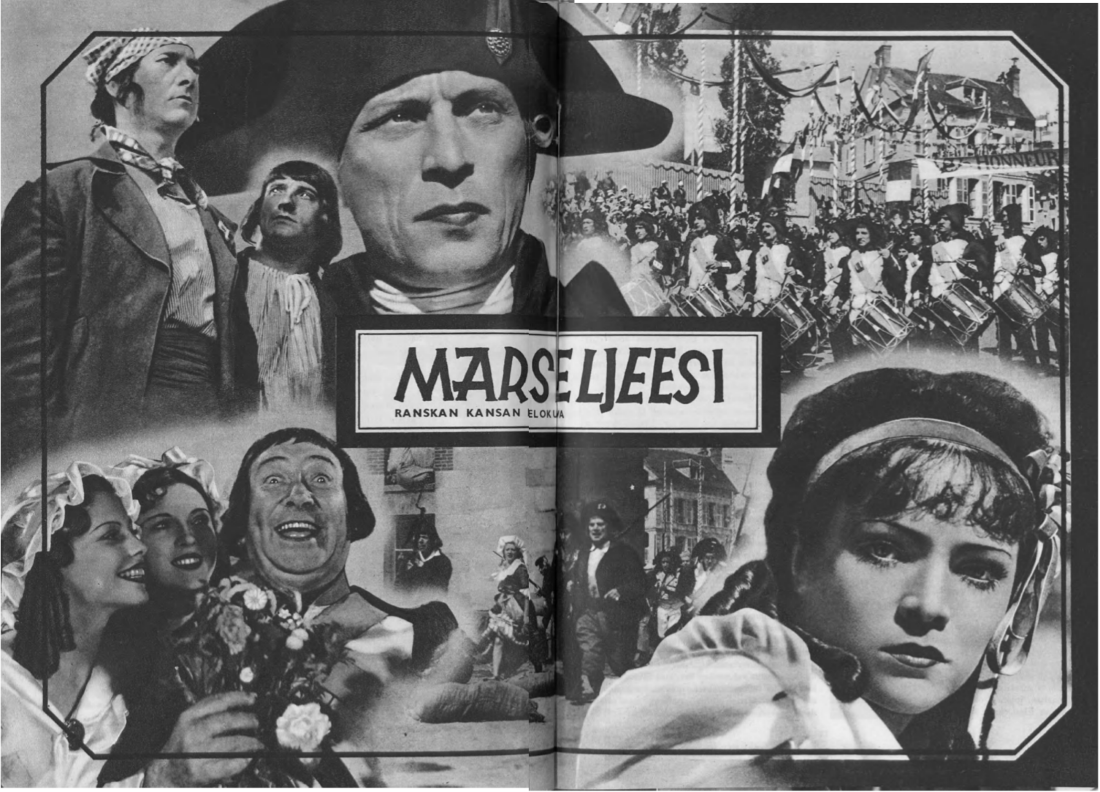
Source: Suomi Filmin uutisaitta 5, 01/05/1938, 8-9.
Subtitles do more than simply translate films, they also redefine their meaning (Nornes 2007). Examining their role in the international circulation of films helps us understand how ideas travel, evolve and adapt to national contexts. Since 1929 and the advent of sound cinema, only 6 % of films screened in Finland have been domestic (Bacon 2016a, 230–231; Hupaniittu 2015) and most of the films screened during the 1930s were either from the USA, Germany, France or Sweden (Pantet 2025a). As Henry Bacon points out, “the economic viability of Finnish film culture has always depended on imports, distribution and exhibition rather than the production of original domestic films” (2016a, 231). In the cinemas of small nations, there has always been an extensive need for imported films, and subtitles have thus always played a fundamental yet largely overlooked role in local film culture. In addition to being influenced by other film industries, 1930s Finnish cinema strengthened its ideological role within the development of a sense of nationhood that made films more than mere entertainment (Laine 1999). Bilingual subtitling (Finnish/Swedish), a successor to bilingual intertitles of silent films, emerged during the interwar period, a time characterised by nation-building, language strife and the rise in far-right radicalism in the country. Technological innovation therefore took place in a particularly nationalistic context.
Although it opens to a whole understanding of how Finland had access to foreign films and also to the tension between domestic cinema’s nationalism and its links to internationalism, the history of subtitling in Finnish cinema has not been yet studied in-depth. Moreover – and as this article aims to underline – without this history, it is challenging to understand why Jean Renoir’s La Marseillaise (1938), an openly left-leaning film with close ties to a communist party, premiered in Finland on 17 April 1938, barely two months after the film’s opening in Paris (on 10 February 1938). Analysing this mechanism highlights the shift between the film’s original meaning and how it was received in Finland.
La Marseillaise is one of the most renowned films of the French Popular Front[1]. Since 1936 and his Crime de monsieur Lange (The Crime of Monsieur Lange), its director Renoir had been a fellow traveller[2] with the French Communist Party (PCF) and an avid supporter of the Popular Front, which won the general election of 3 May 1936. La Marseillaise was intended to be the showpiece of Ciné-Liberté – a film cooperative created in the wake of the Popular Front that aimed to create a radical alternative to commercial cinema and ensure an audience for left-wing films. (Vignaux 2017; Ory 1975; Marie 2013, 329–33; Bowles 2013; Gravouil 2017) – and the PCF-affiliated trade union Confédération Générale du Travail (CGT).
In 1937, Renoir announced an ambitious project to the press: a major 12-hour film on the French Revolution, financed by a national subscription launched by the CGT, in which each participant contributed two francs which amounted to pre-purchasing their ticket for the future screening of the film. Despite a vast campaign, the fundraising did not cover the three million francs needed, forcing the producers to set up a public limited company controlled by the CGT in order to continue the project. Nevertheless, the network of artists, political figures and left-wing organisations formed around Renoir – in a context where the Popular Front sought to use cinema as a cultural and political tool – enabled the production of this ambitious project (Ory 1975, 163–65; Lagny 2020, 119–21). The result is a historical epic film recounting the feats of the Marseille volunteers of 1792, but functions above all as a political allegory of France in the 1930s. By using the revolutionary narrative to evoke the Popular Front, the film celebrates the birth of the revolutionary nation, extols popular unity and offers a republican interpretation of 1792. It thus reinterprets events in a way that supports the ideals of the Popular Front and the PCF, namely a unifying social nationalism bringing hope for an end to the Old World (O’Shaughnessy 2015; Lagny 2020, 121–25; Ory 1975, 168–73).
While the left leaning sentiments were strong in France during the late 1930s, the political stance in Finland was characterised by strong nationalism and anti-communism. Although the country officially sought to maintain a cautious neutrality between the great powers and despite the coming to power in 1937 of a coalition between the Social Democrats and the Agrarians, which introduced significant social reforms, the situation in Finland remained complex and a general mistrust of the Soviet Union and communism persisted (Clerc 2023, 35–39). The Finnish Communist Party had been banned since 1918 and anti-communist laws of the early 1930s had taken restrictions on the left’s freedom of action to the extreme. In addition to being part of the trauma of the civil war, this ban reflected a persistent fear of the Soviet subversion as a hotbed of unrest and a military threat, fuelling an atmosphere of mistrust, ideological tensions and increased vigilance against left-wing ideas and aspirations (Clerc 2023, 38–39).
Consequently, the attempt by a small group of Finnish intellectuals to spread progressive, anti-fascist and pacifist ideas in Finland, inspired by the Popular Front, met with hostility from nationalists and had only limited political influence (despite their lasting impact on Finnish cultural and literary life) (Koivisto 2015). Furthermore, it should be noted that the film’s distributor is none other than Suomi-Filmi, the country’s largest production company, which by far had no left-wing sympathies but rather promoted a nationalist, paternalistic and conservative discourse in its films (Pantet 2025b).
Thus, the context for reception of La Marseillaise was not the same in Finland than it had been in France. This calls for a comparative analysis that takes into account variations in translation. It therefore appears that La Marseillaise, a film marked by ideology, was received within a complex sociocultural and linguistic context. Given the context of its reception, it is difficult to understand how the film could have been staged in Finland, but analysing the subtitles can offer avenues for understanding it. By placing audiovisual translation at the heart of the analysis, this article thus offers a twofold benefit: it provides essential tools for thinking of translation as a cultural and political act, capable of permanently transforming the reception of films and their place in history.
Our research question is then how do subtitling practices and the Finnish reception context of La Marseillaise contribute to alternative semantic interpretations that depart from the film’s established Popular Front reading? Subsequently, can these differences be understood as the result of localisation processes, particularly in subtitling and distribution, and if so, how do they transform the film’s political message?
For this research, we follow in the footsteps of film studies scholars working on the historical understanding of translation practices within the context of cinema and the audiovisual sector. Our work draws in particular on the insights of Carol O’Sullivan, who demonstrates that the audiovisual industry is in fact based on constant, often invisible yet crucial “translational transactions” that shape the intercultural reception of films (2011, 5–6, 117–19). As she points out, “[linguistic] representations are inescapably linked with the political, commercial and sociocultural contexts of their production” (2011, 38). Translation not only contributes directly to the construction of an intercultural imagination, it also enables a better understanding of the transnational history of cinema (Nornes 2007, 19–27).
Such an approach, however, requires particular attention to be paid to the unstable physical nature of film copies and archived documents. Indeed, such research is confronted with an incomplete and heterogeneous archive: rare copies, multiple versions depending on the region, fluctuating terminology in the press, a recurring lack of crediting for translators, and discrepancies between what critics say and what the preserved copies show (O’Sullivan 2019, 282–84; O’Sullivan & Cornu 2019b, 15–18; 2019a, 292). Faced with this fragmentation, it is necessary to adopt an approach that systematically combines the analysis of existing copies, press data, production documents, and cross-version comparison. This methodology enables a history of subtitling as a historical object in its own right, revealing the conditions of reception, the tensions between linguistic nationalism and commercial internationalism, and variations in the viewing experience (O’Sullivan & Cornu 2019b, 8–15) in the era of global cinema.
This implies viewing subtitles as cultural and political operations rather than merely as a tool for linguistic transfer. Translation practices have shaped the way films have circulated, are viewed, are understood and are reappropriated around the world (Gambier & Jin 2019). Furthermore, subtitles – by creating effects of authenticity or, conversely, of appropriation – contribute to the transformation of the regimes of vision and listening that define each era of cinema (O’Sullivan & Cornu 2019b, 7–8; O’Sullivan 2011, 5). In this regard, subtitling appears not only as a technical solution to the international circulation of films, but also as an instrument of ideological mediation, resulting from industrial, commercial and aesthetic choices (selection of discourse, condensation of text, erasure of sociolinguistic markers) (O’Sullivan 2011, 101; O’Sullivan & Cornu 2019b, 7–14).
For this article, the corpus consists of documents relating to the film held by the Finnish Arts and Culture Agency’s Film Archive Unit, specifically the archive file for La Marseillaise (USC-11159), which contains the 1938 French dialogue script (La Marseillaise – USC-11159, 1938), the 1969 version (La Marseillaise – USC-11159, 1969), the Finnish and Swedish translations (Kaija and Idman 1969), the 2002 Finnish translation (Haataja 2002), as well as visa applications and classification records dating from 1938 (Finnish Board of Film Classification, 31.3.1938) and 1969 (Finnish Board of Film Classification, 17.1.1969) from the State Film Board. In light of the documents available for study, we face a difficulty already identified by various historians of audiovisual translation, namely “that archives do not seem to systematically preserve specific translated versions of films (i.e. the first versions exhibited), or to record details about which translations they hold” (O’Sullivan & Cornu 2019b, 16).
Fortunately, the Film Archive has preserved a large quantity of documents relating to the translation of La Marseillaise, under its finnish title Marseljeesi, and given the limited distribution in Finland, it is possible to gain a certain overview. Additionally, we do not know who the translators of the 1938 version were; we only know those of the 1969 version (Marjatta Kaija to Finnish and Börje Idman to Swedish). The same applies to working conditions and organisational structures for import and translation work within Finnish studios. This is largely because no research has yet been carried out on these issues. In any case, our research must be based on the ground of uncertainty and interpretation, as we reconstruct the sequence of events from the remaining fragments and the necessary cross-references. In this respect, our approach is reminiscent of that of Hannu Salmi, who conducts historical research into the early days of Finnish cinema based on traces and clues (2002, 14–15).
Alongside, this research is supplemented with a close linguistic reading of the subtitles, in addition to a filmic analysis. Indeed, this combination of aesthetic and linguistic analyses is essential for identifying variations in meaning between the French version and the Finnish subtitles (i.e. both those in Finnish and those in Swedish). Drawing on the traces that remain, we aim to offer a strong reading (Dufour 2015, 145–80) of the changes in meaning at play within a single film (the notion of “film” here encompassing the idea of the plurality of its versions).To this end, we draw upon the most readily available version of the film, namely the DVD released by Studiocanal in 2003. This 135-minute version is, it seems, the longest available and corresponds to the advertised running time in the 1969 Finnish Film Board classification application.
To supplement our comparative analysis, we draw upon the film’s screenplay published in L’Avant Scène Cinéma no. 383/384 (Renoir 7. & 8. 1989).To round off our research, we are also making use of various supplementary materials such as studies on French and Finnish cinema of the 1930s, various documents from other archive collections, contemporary newspaper articles, as well as works on Jean Renoir, on La Marseillaise and the filmmaker’s own writings. Generally speaking, this leads us to consider that, in writing the history of the subtitling of a film or cinematography, it is not merely a matter of writing a history of reception, but it is also important to produce a materialist history of films, their circulation and their cultural reappropriation.
A look at the reception
Our first hypothesis is that the film’s discourse was reinterpreted through translation. Given Renoir’s reputation in Finland (Hällström 1936, 108), the effective promotion that took place throughout the project (Ory 1975, 163–65) and the taste for French cinema in Finland (Pantet 2024), it seems to us that the decision makers at Suomi-Filmi saw La Marseillaise as an economic opportunity that outweighed the ideological risk. The film should indeed be seen as part of Suomi-Filmi’s strategy to capitalise on the trend of the time for patriotic historical dramas (Honka-Hallila, Laine & Pantti 1995, 120) This is all the more likely given that Suomi-Filmi took care of the translation and, by extension, could manipulate part of the film’s meaning. The reception must therefore also be considered in terms of deviational translation during the subtitling process (Díaz Cintas 2012).
How was the film received by critics?
In the Finnish film press, La Marseillaise was already being heralded as early as 1937 as a “great film, whose production was financed by the entire French nation” (Elokuva-Aitta 15.8.1937, 333). Thus, it is noticeable that, contrary to reality, the crowdfunding model and the originality of the idea are attributed to all French people and not to the CGT and the PCF. Such an interpretation erases the film’s original revolutionary and anti-capitalist nature by suggesting that the film came about through an effort at national cohesion. In doing so, this shift sidesteps the debate of the time over which party represented the people, but presents the film as the culmination of a patriotic union for national construction. Of all the reviews written about this film, one is particularly interesting. It is that of Paul Hollander, the Paris correspondent for Elokuva-Aitta, who devoted a long, favourable article to the film upon its release in France, although the film had not yet been screened in Finland. For Hollander, the film is a powerful experience, as it portrays the people and is historically accurate:
Its main character is the people. We get to know their thoughts and feelings, their simplicity, their rage, their cowardice, and their bravery. […] Jean Renoir has no stars in this film. The big star is the people. […] Jean Renoir loves the people. He wants to portray the people, his own people, in his film. He wants the people who carried out the revolution to be understood, to be loved. (15.3.1938, 132–34)
Hollander thus emphasises the film’s popular appeal and, by setting aside its political nature, extols it as a national work. Although he describes the film as a masterpiece, he nevertheless acknowledges that it will not appeal to everyone, just as not everyone likes Beethoven’s music. The only open criticism Hollander has of the film is that “the screening of La Marseillaise lasted two hours and 20 minutes as I saw it. This is undoubtedly far too long.” (15.3.1938, 150). Beyond the criticism, this comment provides an important clue as to the film’s reception, namely the issue of the film’s length, to which we shall return.
When the film was released, the critical reception in Finland was not as positive as under Hollander’s quill, though it was by no means scathing. Generally speaking, the specialist press hailed it as a great film, in line with the French press, but expressed disappointment at the film’s lacklustre pacing and the absence of an epic quality. One of the reviews featured in the magazine Suomen Kinolehti sums up this general view: “Considering the subject matter of the film, however, it feels as if ’La Marseillaise’ does not quite live up to expectations. The slow pace and occasional lack of tension threaten to undermine what is otherwise a good achievement” (1.5.1938, 247). The film continues to be described as a historical film about the French Revolution, where “The main role is played by the people themselves” and where the crowd scenes are admired, but the pacing is criticised and it is noted that “it seems that the French, at least at this point, are unable to make such grandiose parade films, in which the Americans – despite their lack of style – have developed quite far” (af Hällström 1.5.1938, 218).
It is interesting to note that Finnish critical reception focuses on the film’s portrayal of the theme of the people and national spirit and on the issue of pacing. Indeed, this differs from the film’s reception in France, where it served as a pretext for an ideological battle between left-wing and right-wing supporters. The former saw it as a genuinely popular epic, whilst the latter denounced it as a film manipulated by the communists and blamed Renoir of betraying art for propaganda deemed dangerous (Ory 1975, 173–74; Bowles 2013, 416–17; Brown 2013, 426). As the collection of French press reviews of the film from that period compiles, reviews were divided between praise for Renoir as a humanist filmmaker at the height of his art, offering a sincere film committed to capturing the atmosphere of the revolution, and accusations against a perceived attempt to manipulate public opinion, though it was felt that the film’s tedium undermined its effectiveness (’[Recueil. “La Marseillaise” film de Jean Renoir]’ 1938). Generally speaking, the French reception was based far more on the film’s ideological nature and emphasised its roots in the context of the Popular Front. As Michelle Lagny summarises regarding the film’s reception:
The critics of the time, whether favourable or hostile, were right: rarely has a historical film had so much of the flavour and atmosphere of the moment when it was conceived and made with collective enthusiasm. […] What is important in the Popular Front, as in the Revolution, is the staging of the symbolic seizure of power by the people and the creation of a myth by recording the event in a great book or a great film, which themselves become mythical. (2020, 124–25)
Nevertheless, La Marseillaise was released in cinemas just as the Popular Front was coming to an end. While the aim was to rally the French people around a political project, the film coincided with the end of that very project. (Musser 2013, 284; Bowles 2013, 416–17; O’Shaughnessy 2000, 139–42; Huzar 2025, 78)
Above all, there is a marked difference in how the film was received in France and Finland. The former emphasised left-wing populism and the revolutionary fervour of the people, whilst the latter focused on the people as a national whole and their aspiration for freedom. The blurring of oppositions – by which we mean the film’s desire to affirm the legitimacy and prevalence of the Popular Front’s definition of the French nation and people – in favour of a homogeneous image of the population – in this case, that the film is the work of the French people as a whole – is characteristic of the Finnish film industry of the time, particularly the national studios (Suomi-Filmi and Suomen Filmiteollisuus), which at that time produced films of nationalist prestige and used cinema as an instrument for expressing Finnish identity and national cohesion (Laine 1999, 249–253).
An important caveat here is that since our window onto the Finnish reception of the film is mediated through professional critics, which have a socio-economic position of their own that isn’t representative of the diversity of the Finnish people, we cannot assume general popular sentiment from the voices analysed here. In this regard, we limit ourselves here to the observation that the film was screened three times a day at the Kino Palatsi, a prestigious 750-seat cinema in Helsinki. However, the fact that it was taken off the programme the following week suggests that the success the distributor had hoped for did not materialise (Helsingin sanomat 17.4.1938). The film reappeared on screens in Helsinki in July 1938, but at a smaller cinema (the Scala) and, once again, for just one week. This corroborates what seems to have been a lack of public success.
Nevertheless, and while it reduces the scope of our conclusions, comparison between critics in France and Finland remains informative as we consider them to hold similar class positions in their respective societies. Following Janet Staiger (1992, 92–97), we consider that films, as artefacts, do not contain intrinsic meanings, and that differences in interpretation are linked to social, political and economic conditions, as well as to the images that viewers construct of themselves. This approach highlights the role of critics as participants in a historical process of meaning-making, who help to shape audience identities and cultural discourses surrounding films. We therefore do not regard criticism as a transparent window onto the public, but as a subjective subject of study in its own right, which nevertheless reveals something about national imaginaries as they circulate, about international exchanges and about cultural power relations.
In the context of La Marseillaise, the difference in interpretation is not without foundation; rather, it comes down to the perspective from which the film is viewed. Indeed, the film maintains ambivalence among left-wing inspirations and the desire for national unity. It illustrates the Popular Front’s attempt to reclaim French nationalism and its symbols from the right and the far right (Ousselin 2009, 118–20). It also develops the “main tendue” policy devised by Maurice Thorez, the General Secretary of the French Communist Party. This policy was the invitation extended to Catholics and the middle class to achieve national reconciliation in the interests of France and against the temptation of fascism and Nazism (Thorez 17.4.1936). This perspective is reflected in the film’s portrayal of the revolution not as a conflict between different social classes, but rather, to quote Pascal Ory, “after all, nothing but the vital expression of the vast majority of the French people against a handful of diehards” (1994, 455). Attributing revolutionary aspirations not to a faction but to more or less the entire French people erases internal divisions within the French people and reinterprets the event as a national cause. The film itself, with its call for national reconciliation, thus opens the door to a nationalist reading of its message.
It should also be emphasised that Jean Renoir’s political stance was complex, oscillating between sympathy for the left and a critical detachment, reflecting his bourgeois background and his status as an artist with a distinctive style. Consequently, Renoir’s films from the Popular Front period should be regarded as cinematic interventions within a turbulent era of ideological and political debates and struggles, but not merely as simple reflections of the Popular Front’s ideas (Musser 2013; O’Shaughnessy 2000, 101–53; Marie 2013). As Raymond Durgnat points out:
Insofar as the film identifies the interests of the nation with that of its lower-class majorities, it is more Marxist than it seems. Insofar as it sees some hope of class reconciliation, Marxists must consider Renoir as a bourgeois liberal, maybe useful during a Popular Front tack, but to be repudiated at other times. (1974, 166)
In the continuity of Thorez’s famous “main tendue”, the film takes up a theme dear to both Renoir and Thorez’s PCF, namely popular and national unity against the foreign aggressor (Ousselin 2009, 118–20; O’Shaughnessy 2000, 133–34), particularly that from Germany as is often the case in French films of the 1930s (Beylie 1991).
A key aspect surrounding the Finnish reception is that unlike the French audience, the Finnish one is watching a foreign film. Indeed, the film’s political significance depends on the viewer’s ability to draw connections between the events of the revolution and the contemporary French context. These connections were acknowledged by Renoir himself, who, for example, linked the aristocratic ideals of the time to the fascist ideas of his era, and these parallels were very much in the minds of French critics (Ory 1994, 454). However, as these interpretative keys depend on knowledge of the French context, it is not surprising that the Finnish critics, who are likely to be less familiar with it, more readily accepted the view that the revolution was the subject of a consensus among the French people, rather than the result of class conflict. Furthermore, their social standing as part of the intelligentsia may have steered their reading of the film away from a historical materialist viewpoint and therefore facilitated a nationalist interpretation. Once again, this article cannot ascertain how prevalent this tendency was within the broader Finnish public.
Consequently, the prevailing interpretation in the Finnish press, which emphasises the film’s nationalistic character, should be understood primarily as a focus on a specific aspect of the film rather than as a misreading of it. Although it is not possible to know whether this was done consciously or unconsciously, we can nevertheless perceive here one of the facets of the limits of what is visible in a society, as they emerge from the film (Sorlin 2015, 42–67).
Which version was shown in Finland?
The question of ambivalence and reinterpretation invites us to examine the archival documents more closely. On this point, the question of which version was screened becomes crucial, as one might wonder whether the Finnish audience had access to the same film as that discussed by French critics or by researchers who have studied it retrospectively.
After 1938’s initial release run, La Marseillaise almost fell into oblivion until a copy repatriated from Moscow enabled Renoir to produce a reconstructed version, for which he reacquired the rights to the film and re-released it in Paris on 27 October 1967 (Mérigeau 2012, 883). Furthermore, it should be noted that attached to the Finnish classification application dated 1969 is an explanatory note regarding this new visa application, which states that “Jean Renoir’s famous film from 1938 is now being shown in its entirety for the first time. The film was shortened around the time of its premiere, and during the war some of the negatives were lost until they were found in the Soviet Union, so now the film is finally complete” (Finnish Board of Film Classification, 17.1.1969). This reconstructed version premiered in Helsinki on 21 January 1969. The film is therefore characterised by a “rediscovery” and thus a double reception in Finland (or even triple if we consider the retranslation of the film in the 2000s). Thus, in addition to the hypothetical complexity of the 1938 reception and the influence of subtitles on the production of meaning, there is also a temporal paradigm.
On reading the 1938’s applications for preliminary review, it is clear that the 1938 version had been shortened by a third compared to its original (without specifying whether this refers to the French or Finnish version) (Finnish Board of Film Classification, 17.1.1969). Indeed, it appears that the copy screened in Finland in 1938 is 3,400 metres long, i.e. approximately two hours and four minutes (Finnish Board of Film Classification, 31.3.1938). However, the film is listed as being 3,780 metres long (approximately two hours and twenty minutes) in the 1969 application (Finnish Board of Film Classification, 17.1.1969). It is actually more than likely that the film is shorter rather than the given length. Indeed, the film was scheduled as a triple feature in the cinema Kino Palatsi, with screenings at 5.15 p.m., 7.15 p.m. and 9.15 p.m (Helsingin Sanomat 17.4.1938) and then, during summer, as a double feature in the cinema Scala, with screenings at 7.15 p.m. and 9.15 p.m., i.e. two hours apart (Helsingin Sanomat 24.7.1938). This suggests that the version screened in Finnish cinemas in 1938 was about two hours long.
This echoes Hollander’s previously cited wish, but is also confirmed by the article published in La Cinématographie française reporting a new edit of the film by Renoir dated 1 March 1938, which reduces the film’s running time to one hour fifty-five minutes instead of the original two hours twenty-five minutes. The article mentions the removal of the sequence depicting the poacher’s trial, the sequence set in the maquis, as well as the majority of the interactions between the queen Marie-Antoinette and the representative of the National Assembly, Rœderer. It concludes that the film gains in pace and in balance (La Cinématographie française 4.4.1938). This re-edit is confirmed by a scathing article in the journal Cinædia, which considers that the film remains just as “partisan” and devoid of emotion despite the 800 metres cut (12.3.1938), but also by a journalist from L’Humanité, who attempts to reassure readers about this re-editing by arguing that it is not a case of censorship, but a necessary re-editing, as the film is too long for the specific programming requirements of the cinema where it is being screened (L’Olympia) (Cheronnet 4.3.1938). This therefore explains the difference in running time between the two visa applications.
Several points can be drawn from this information. First, the version released in Finland is neither the one shown at the film’s French premiere nor the version reconstructed in 1967. Furthermore, the re-editing took place in France, and it can be assumed that this was done under pressure from distributors in response to an unsatisfactory opening for the film. On the subject of Renoir’s films, Olivier Curchod has already reported on cuts made after the release of La Règle du jeu (The Rules of the Game) (Jean Renoir, 1939). These cuts, “demanded by the two cinema managers to quell the uproar at the first screenings and ensure the film’s success, were made by the editor directly on the prints” (2000, 104). The editor in question, Marguerite Houllé-Renoir, was a loyal collaborator of Renoir’s, as well as his partner during the 1930s. Having worked on La Marseillaise, it seems likely to us that she was also responsible for the cuts made in March 1938. Moreover, the pressure from distributors is implicit here and in Louis Cheronnet’s article. It is here important to remind that the coexistence of different versions was not unusual during the silent and studio eras (and, in fact, this is still the case today) (Frappat & Thomas 2026).
We echo here Curchod’s conclusion, namely that the film “which we have been watching and discussing for [seventy] years is not the film that its author had – rightly or wrongly – fashioned in his editing room” (2000, 106). Finally, given the short time between this new version and the review by the Finnish Board of Film Classification – exactly one month – it is also not surprising that it was the dialogue list from the first version that reached Finland.
This explains why certain excerpts of the dialogue script – 19 to be precise – which served as the basis for the 1938 Finnish subtitling, are crossed out (La Marseillaise – 21503 1938). Indeed, the excerpts mentioned in the article in La Cinématographie française are crossed out in the document; others are arranged in such a way as to correspond to continuity shots, suggesting a particularly meticulous re-editing process that someone outside the film crew would likely not have bothered to carry out. Furthermore, there is a handwritten comment asking “is this missing?”, in the margin of the dialogue sequence between the queen and Rœderer. Thus, the document allows us to identify more precisely the excerpts removed from the film. Specifically, the sequences that have been crossed out include the trial for poaching and the Maquis sequence at the beginning of the film, the sequence featuring the émigrés from Koblenz, the political discussion between the two national volunteers in Valenciennes, the start of the scene at the Marseille club when the woman named Louise Vauclair speaks, various moments where the king attempts to analyse the situation, as well as the majority of the exchanges between the queen and Rœderer.
The common thread running through these sequences is that they invite a left-wing political interpretation and convey a socio-political critique. Through class conflicts, the denunciation of privilege, mistrust of traditional elites, the celebration of organised working people, the need for alliances between the working classes and the republican petty bourgeoisie, and the desire for social reforms carried out in an orderly manner or the defence of national unity against reactionary forces, these sequences constitute, under the guise of historical reconstruction, a socio-political critique inspired by the left-wing ideas of the 1930s and directly echo the context of the Popular Front. In this respect, these sequences are among the most explicitly militant in the film and serve the ideals of the Popular Front, at least as conceived by Renoir. This insight allows to perceive that these cuts might have been more politically motivated than Louis Cheronnet was then attempting to euphemise away (1938). Although Marcel Collet does not do the film justice with his viciously right-wing critique, his article is interesting because it points out that the new version was made under pressure from distributors who insisted on seeing the film made less political and toned down (Collet 27.5.1938).
Our interpretation therefore differs from François Huzar’s regarding the film’s re-editing, which relativizes the political nature of the censored sequences (2025, 300). It also puts into perspective some of the sweeping analyses of the film based on the version currently available. Furthermore, this helps to clarify studies on the editing work carried out by Marguerite Houllé-Renoir for La Marseillaise (Sidhu 2021) by highlighting the vicissitudes the film underwent, notably the cut at the beginning of Louise Vauclair’s speech, which is at the heart of Sidhu’s analysis.
However, the crossed-out sections in the dialogue list do not allow for a faithful reconstruction of the March 1938 version of La Marseillaise. They relate only to the dialogue, so potential cuts to non-dialogue sections are not indicated there. Furthermore, there is some uncertainty regarding the copies distributed internationally. We know that the version we are familiar with today was reconstructed by Renoir in 1967, notably thanks to a Soviet copy of the film (Art et Essai 10.1967). However, in this version, only 4 of the 19 crossed-out sections are missing. Consequently, we can assume that the film released in the Soviet Union is longer than the one that reached Finland, but also than the version that was screened in France after the premiere cuts. In other words, the full-length version was reserved for a communist audience, which proves its political nature. More specifically, the Swedish visa application indicates a running time of 2858 metres (Svensk Filmdatabas 2026); the copy held in the Bundesarchiv is listed as 3061 metres (2026); as for the information in the database of the Centre National de la Cinématographie (CNC) – the film having received a visa retrospectively (1942 according to the source)–, the length indicated is 3960 metres (CNC 2026) (which appears to be closer to the running time of the original version). These variations between copies corroborate the difficulty to establish what version of the film was shown in Finland.
Finally, some sections of the dialogue list are numbered for subtitling. We may therefore assume that they were translated, which seems surprising given that others were not, namely those mentioned in the article in La Cinématographie française (1938). Without drawing any conclusions, we nevertheless propose the hypothesis that the versions were re-edited at the discretion of the distributors. Whether to avoid censorship or to condense the film, but also in view of Suomi-Filmi’s ideological alignment, the hypothesis of additional cuts is not impossible. Furthermore, if this is the case, it seems to us that the most appropriate time to do so is undoubtedly during the subtitling process. Although this is merely an interpretation, it invites us to put the ethics and transparency of audiovisual translation into perspective.
It has been proven, time and again, that translation can also emphasise differences, perpetuate the wrong stereotypes, and deliberately misinform, thereby burning the very bridges it was supposed to build.
Seen as one of the most important fields both from a social and professional perspective, in terms of the sheer quantity of translated programmes, the revenue it generates, and the vast number of people it reaches, AVT lends itself aptly to a discussion and investigation of questions relating to power, ideology, dominance, intervention, ethics, identity, and manipulation. (Díaz Cintas 2012, 291)
Thus, we believe it is important to cultivate doubt and to question, not the professional ethics of translators and workers in the Finnish industry, but rather the ideological structures, which we suspect of prioritising their own interests at the expense of fidelity to the original text.
A closer look at the Finnish bilingual subtitles
Carol O’Sullivan and Jean-François Cornu note that “cultural translation could also be influenced by the ideological rules of the place and moment, which led foreign films to be edited (in all senses) in a different way than their original version, and altered not only in their dialogue but even in their narration” (2019b, 7). It is this phenomenon that we have observed in the Finnish critical reception of La Marseillaise, which emphasises the film’s patriotic dimension. To support this, we believe it is important to analyse the texts themselves through close reading of the available documents.
Missing signs: the ideological nature of the condensation of subtitling, using addresses as an example
First, we shall focus on the fact that 594 subtitles are listed in the 1938 dialogue script, whereas the 1969 version contains 1 487. We are aware that this quantitative difference must take into account the fact that these are the adaptators’s working notes and that variations between versions affect the number. Also, in the 1930s, the practice was that only the most important dialogue was translated, not all of it (Cornu 2014, 276–9, 359). However, even taking this margin into account, it remains clear that the 1969 version is more fully translated than the 1938 version. We can therefore hypothesise that any elements missing from the 1969 subtitles compared to the spoken dialogues were likely also missing from those of 1938; in other words, we will not assume that further deletions were made during the film’s second screening. We therefore work under the following assumption: what is missing from the 1969 version was probably removed as early as 1938. This is also evident in excerpts where there are no marks to suggest that the text has not been translated. Furthermore, based on the difference of context – that is the fact that 1930s Finland was more conservative than the 1960s one and the information on reception in Finland – we suppose that the 1938 version was more ideology modified than the 1969 one.
However, before concluding that these omissions are signs of a deliberate omission, it is important to bear in mind that subtitling involves formal constraints on the length of the subtitle. This condensation of subtitling involves reducing and simplifying spoken dialogue in order to comply with the strict constraints of the subtitle (1 to 2 lines, approximately 35 to 40 characters each) and to preserve the legibility of the image. Indeed, subtitles intrude on the bottom edge of the image, affecting its aesthetics (and meaning) and distracting the viewer’s attention. To minimise those inconveniences, but also but also the costs of producing subtitles, the adapter must eliminate repetitions, hesitations and secondary details, ideally retaining only the essential meaning, reformulating it more concisely, respecting the rhythm of the dialogue and allowing the viewer to read quickly so they can return to the image (Cornu 2014, 339–40, 355–61, 371–72). Added to this condensation is the specific nature of the bilingualism of Finnish subtitles, which allows only one line per language and thus halves the space available to the translator. We must therefore bear in mind that a number of omissions may be due to these technical constraints, rather than ideological choices. It is therefore not easy to guess the intentions behind a given change. Nevertheless, the consequences of these alterations to the text may affect the film’s ideological scope. We consider at the very least that preserving these elements was not a priority for the translator, which constitutes positioning in itself.
We will, for example, offer an ideological interpretation of these omissions. One of the most frequent and consistent omissions in the Finnish or Swedish subtitles is that of addresses. Names, titles and other forms of direct address are almost always omitted from subtitles. There is a technical reason for this: the address often contributes little to the overall meaning of the line, and the viewer can understand who is speaking to whom without the aid of subtitles. However, they are sometimes retained, as in the following line:
| Timecode | 220 (00:16:35) |
| Original | Adieu, mon vieux Cabri. |
| Our translation | Farewell, my old Cabri. |
| Finnish/Swedish | Hyvästi, Cabri / Adjö, Cabri |
| Direct translation of subtitles | Farewell, Cabri/– |
It is worth noting that the line is very short. We can conclude that certain deviations from the rule regarding the removal of addresses are indeed permitted, provided that retaining them does not contravene constraints of space and time. These rules are therefore contextual rather than systematic; in other words, they are flexible and involve an element of discretion.
| Timecode | 49 (00:07:00) |
| Original | Monsieur le Comte, Charbonnier est maître chez lui. |
| Our translation | My Lord, Charbonnier is the master in his own house. |
| Finnish/Swedish | Hän oli omalla maallaan / Han var på sin egen mark |
| Direct translation of subtitles | He was on his own land/– |
We see here that the title of nobility has been omitted from the subtitles. It is nevertheless clear that the mayor is addressing the Count even without it. This is therefore an easy way for the translator to save space at little cost from a strictly semantic point of view. However, this omission is not entirely neutral from an ideological perspective. Indeed, forms of address convey information not only about the respective status of the conversation’s participants, but also about their dynamics and their perception of these statuses. Thus, the recurrence of titles of nobility serves as a constant reminder of the aristocrats’ presence, their difference in standing, and the obligation of commoners to observe certain conventions when addressing them. Their omission in the subtitles amounts to a kind of erasure of these status differences, even though they constitute a significant aspect of the revolutionaries’ motivations. The inequality of status between the characters is then only visible through the use of the formal “vous” form of address, which is, for both languages, retained in the subtitles. It should also be noted that the scene from which this line is taken is that of the poacher’s trial, which, as we have said, was not present in the 1938 version. The decision to remove the forms of address was therefore made in 1969, but we rely on our hypothesis to assert that they were probably also absent from the 1938 subtitles.
Apart from titles of nobility, the other category of forms of address carrying social significance is that used by the revolutionaries. The most common are the terms “citizen” (citoyen) and “comrade” (camarade). It is difficult to argue that these omissions are due solely to constraints of time and space. The following example makes this clear:
| Timecode | 294 (00:22:35) |
| Original | Alors, donne-moi la main, mon camarade. |
| Our translation | So, give me your hand, comrade. |
| Finnish/Swedish | Anna kätesi/Ge mej din hand |
| Direct translation of subtitles | Give me your hand/– |
We can see here that the lines are very short, 11 and 16 characters for Finnish and Swedish respectively, and that there was ample space to add the words for “comrade” in both languages (respectively “toveri” and “kamrat”) without having to add a new line of subtitles. However, unlike example 220 above, the term has been omitted from the subtitles. It therefore appears that the justification for this omission is indeed ideological. To be convinced of this, one need only note that there are very few instances of the word throughout the film, whereas it is relatively frequent in the dialogue. Furthermore, it is sometimes omitted even when it is not an address.
| Timecode | 297 (00:22:45) |
| Original | Vous serez bien gentils de remettre vos fusils à mes camarades. |
| Our translation | You will kindly hand over your rifles to my comrades. |
| Finnish/Swedish | Luovuttaisitteko ystävällisesti aseenne / Var vänlig och överlämna ert vapen |
| Direct translation of the subtitles | Would you kindly hand over your weapons? /Please hand over your weapon |
These subtitles highlight some of the translator’s priorities. It was considered important in the translation to convey Bomier’s ironically polite tone, even though this is not strictly necessary to understand the scene, and is relatively costly in terms of signs. Conversely, removing this nuance in favour of referring to “comrades” would, for example, result in the following line: “Luovuttakaa aseenne tovereilleni / Överlämna era vapen till mina kamrater”, which is slightly shorter than the one chosen. Beyond the constraints, there is therefore an active choice on the part of the translation team.
Changes in language registers and their effects
Comparing the dialogue with the subtitles highlights a second phenomenon: there is a clear tendency to tone down the crudeness in the dialogue. One line stands out in particular, when Bomier suggests taking a woman with them, and Cabri replies derisively:
| Timecode | 152–153(00:13:00) |
| Original | Et puis vous vous foutriez sur la gueule, parce qu’il y en a un qui voudrait la garder pour lui tout seul ! J’ai compris ! |
| Our translation | And then you’d be at each other’s throats, because one of you would want to keep her all to himself! I get it! |
| Finnish/Swedish | Ja te olisitte alinomaa toistenne kimpussa / Och ni skulle jämt vara i luven på varandra Siitä kumpi saa pitää tytön / Om vem som fick hålla flickan |
| Direct translation of the subtitles | And you’d be constantly arguing over who gets to keep the girl/– |
The expression “se foutre sur la gueule” (to fight one another, to be at each other’s throats) is colloquial, even openly crude, whereas the translations “olla kimpussa”/“vara i luven” do not carry this connotation. There are, however, ways to express the same meaning idiomatically while retaining the tone of the French line, such as the more colloquial constructions “antaa turpaan” and “ryka ihop”, which could have been used instead. This change, once again, is therefore not a technical necessity but a matter of choice. Nor is this an isolated example. A little later, when castles are burning, Bomier makes the following comment:
| Timecode | 203 (00:15:45) |
| Original | Tout de même, les seigneurs ils vont en faire une drôle de gueule ! |
| Our translation | Still, the lords they are gonna make quite a funny face! |
| Finnish/Swedish | Eivät herrat taida riemuita / Herrarna lär nog inte fröjdas |
| Direct translation of the subtitles | The lords won’t be pleased. /– |
The word used for “face” in French, “gueule”, which was also part of the previous example, belongs strictly to the cruder language registers. On the contrary, the choice of translation in Finnish and Swedish carry a euphemistic and slightly ironic tone, but removes the crudeness of the original word completely. It would therefore seem that the translation refrains from conveying obscenities. This choice appears to be confirmed when a line that could be interpreted as blasphemy gets its edge sanded off in the subtitles.
| Timecode | 166 (00:13:35) |
| Original | On peut remercier votre Bon Dieu que vous soyez l’ami d’enfance d’Arnaud |
| Our translation | We can thank your Good Lord that you’re Arnaud’s childhood friend. |
| Finnish/Swedish | Voimme kiittää hyvää Jumalaa / Vi kan tacka den gode Guden Siitä että olette Arnaudin ystävä / för det att ni är Arnauds vän |
| Direct translation of the subtitles | We can thank the Good Lord that you are Arnaud’s friend/– |
The original line highlighted the protagonists’ atheism. We can assume that these examples reveal a more general tendency to censor the characters’ words deemed inappropriate, perhaps as a reflection of the localisation team’s conservative values, or to avoid, as a matter of course, offending the values they anticipate in their audience. In any case, this rule has very real political consequences.
Indeed, it is significant that, in all the examples we have identified, and in the film generally, the profanities are uttered by working-class characters who are sympathisers of the revolution, and they use a language that is consistent with their social position. The toning down of their language removes this link between their social class and their political positions; in doing so, it helps to obscure the class divisions that are expressed, among other things, through the way people speak. It is also possible that some of this censorship was necessary to ensure the audience’s sympathy for the protagonists. This would explain the disappearance of one line in particular, a few minutes later. While Bomier and his comrades are criticising their lords, Cabri says the following:
| Timecode | 211 (00:16:00) |
| Original | Ils sont comme certains animaux nuisibles, c’est pas leur faute. |
| Our translation | They are like certain pests, it is not their fault. |
| Finnish/Swedish | Ei se ole heidän syynsä / Det är inte deras fel |
| Direct translation of subtitles | It’s not their fault/– |
The speech as a whole is present in the 1969 version, including the assertion that it is in the nature of aristocrats to do evil. However, the removal of this particular line can be interpreted as a sign that the comparison with pests was a step too far for the Finnish translators, and that it was removed so as not to shock the viewer. The cumulative effect of removing the most socially or ideologically charged aspects of the dialogue is to limit the potential friction between the characters’ positions and those of the audience.
This would partly explain the difference in how the film was received in France and Finland. Finnish critics, as we have seen, reacted primarily to the film’s national character rather than to the divisions between classes and political camps that caused controversy in France, and the blurring of these class divisions in the translated version may have contributed to this perception. There were simply fewer reasons for Finnish viewers to associate the protagonists with particular ideological positions or class identities. The translation makes it easier to identify Cabri, Bomier and the others with the people as a whole, rather than with a particular faction within them.
Furthermore, the shift in language registers in the Finnish version has another effect. The translation of line 203 is not only more literary, it also makes use of relatively archaic words. The effect produced is therefore not simply to erase the characters’ class-specific traits, but also to emphasise the film’s historical aspect. A colloquial expression in this context would have anchored the characters in the present day, as it would have seemed out of place in a historical work. The dissonance is even stronger in a work with an epic tone, as the Finnish critics expected to see.
We can therefore, once again, partly attribute the divergence in reception to differences in the texts. Suomi-Filmi’s translation choices, whether consciously or not, emphasised the historical or mythical nature of the work, thereby distancing it from the present day. This distancing is compounded by geographical distance: what was perceived by the French as a local film relevant to the present becomes, for the Finnish audience, the distant history of a foreign country. The result is a palpable depoliticisation of the film; the characters thus become distant, less socially defined and tied to a bygone era.
Conclusion
In conclusion, the difference in how the film is received in the specialized press in France and Finland is therefore due to at least three factors. The first stem from the film’s tendency, in line with the ideas of the Popular Front, to present the French Revolution as an event uniting the French people as a nation, rather than as a reflection of internal class divisions within it. The second is the difference in the audiences of the two countries. Finnish viewers may not, a priori, have the same familiarity with the country’s politics as the French, and may miss some of the parallels the film draws between the events of the revolution and the ideological conflicts of the present. Consequently, part of the film’s political significance may be inaccessible to the Finnish audiences, who are therefore more likely to readily accept the nationalist interpretation of events. Finally, the two audiences did not have access to the same text, as Finnish viewers experienced the film through subtitles. However, the changes these subtitles introduce compared to the original dialogue further alter the film’s interpretative possibilities, and these changes are not ideologically neutral. The strict length constraints that bilingual subtitles must adhere to force the translator to make choices, through which they express a certain number of priorities. The importance of maintaining the more left-wing political aspects of the film seemed to be on the lower end of that set of priorities. The result, whether intentional or not, is an alteration of the message that further downplays its political content, and facilitates a nationalist interpretation of the film.
On a more general level, this case study unveils the importance of subtitling practices in the analysis of film reception and, to a larger extent, in the understanding of a small nation cinema’s history. By illustrating the complexities lying within the impact of international films in Finland, it highlights the fundamental importance of subtitling in the history of Finnish cinema. The history of audiovisual translation within the Finnish and Nordic cinemas is a rich area for reflection, involving specific translation work, major economic considerations and also crucial aesthetic choices. It combines issues relating to the industrial and cultural aspects of cinema, with subtitles being the means chosen by Finnish studios to provide access to foreign films and, by extension, to other cultures.
History of subtitling in Finland provides a unique vantage point for observing these dynamics, and why it is crucial for understanding the tensions between nationalism and internationalism within the cinema of a small nation heavily dependent on foreign imports. This article exemplifies the richness of such research, as it would provide a better understanding of its impact on audiovisual perceptions of the world from Finland and would deepen our understanding of films societal roles within Finland. As a well preserved small national film culture, it is possible to write a comprehensive history of Finnish cinema’s subtitling practices. On an international scale, this would provide a rare example of a comprehensive history of subtitling practices and thus contribute to a much-needed discussion within film studies.
Funding
This project has received funding from the European Union’s Horizon Europe research and innovation programme under the Marie Skłodowska-Curie Actions grant agreement No. 101081293.
References
All links verified 5.11.2026.
Archives
Art et Essai 10.1967. ‘À Propos de La Marseillaise’. Art et Essai, no. 32 (October), 4.
Bundesarchiv. 2026. ”Marseillaise (1938) (Übernahmetitel) – Digitaler Lesesaal”. Digitalen Lesesaal des Bundesarchivs — Film.
https://digitaler-lesesaal.bundesarchiv.de/en/video/454616/357897
Cheronnet, Louis, 4.3.1938. “Cinéma”. L’Humanité 4.3., 7.
Cinædia 12.3.1938. “New Films: La Marseillaise”. Cinædia, 8.
CNC. 2026. ”La Marseillaise – Visas et Classification”. FranceArchives: Centre national de la cinématographie et de l’image animée.
https://www.cnc.fr/professionnels/visas-et-classification/2184
Collet, Marcel 27.5.1938. “La Marseillaise”. Salut Public, 27 May 1938, 6.
Elokuva-Aitta 15.8.1937. “Suomi-Filmin ulkomaista ohjelmistoa”. Elokuva-Aitta, 332-333.
Finnish Board of Film Classification 31.3.1938/21503. “Elokuvan tarkastusanomus: La Marseillaise”. Kuvi – Elokuva-arkisto-yksikkö.
Finnish Board of Film Classification 17.1.1969/21503. “Elokuvan tarkastusanomus: La Marseillaise”. Kuvi – Elokuva-arkisto-yksikkö.
Haataja, Kristina. 2002. “La Marseillaise – suomalaiset tekstitykset”. La Marseillaise – 21503. Kuvi – Elokuva-arkisto-yksikkö.
Helsingin Sanomat 17.4.1938. “Kino Palatsi – Marseljeesi”. Helsingin Sanomat, 5.
Helsingin Sanomat 24.7.1938. “Scala – Marseljeesi”, Helsingin Sanomat, 3.
Hollander, Paul 15.3.1938. “Marseljeesi, kansan elokuva”. Elokuva-Aitta, 132-134 & 150.
Hällström, Roland af 1936. Filmi – aikamme kuva: filmin historiaa, olemusta and tehtäviä. Helsinki: Gummerus.
Hällström, Roland af 1.5.1938. ”Paljon ranskalaista tällä kertaa”. Elokuva-Aitta.
Kaija, Marjatta & Börje Idman. 1969. ”La Marseillaise – suomalaiset tekstitykset / svenska undertexter”. La Marseillaise – 21503. Kuvi – Elokuva-arkisto-yksikkö.
La Cinématographie française 4.4.1938. ”La version définitive de LA MARSEILLAISE a été présenté à la presse”. La Cinématographie française.
La Marseillaise – USC-11159. 1938. ”La Marseillaise – dialogilista”. Kuvi – Elokuva-arkisto-yksikkö.
La Marseillaise – USC-11159. 1969. ”La Marseillaise – dialogilista”. Kuvi – Elokuva-arkisto-yksikkö.
Recueil ”La Marseillaise” film de Jean Renoir. 1938. Manuscript, BnF Gallica. https://gallica.bnf.fr/ark:/12148/btv1b10507487d
Suomen Kinolehti 1.5.1938. ”Otteita ensi-ilta arvosteluista”. Suomen Kinolehti.
Svensk Filmdatabas. 2026. ”Marseljäsen (1938) – Censurnummer 57459 – SFdb”. Svensk Filmdatabas.
https://www.svenskfilmdatabas.se/sv/item/?type=film&itemid=28427
Thorez, Maurice 17.4.1936. L’appel au Peuple… Front Français, Aired on Radio-Paris. Internet Archive: Wartime Radio 1936.
https://archive.org/details/WartimeRadio1936/17-04-1936MauriceThorez.mp3
Films
Jacques Becker, Jacques Brunius, Henri Cartier-Bresson, Jean-Paul Le Chanois, Maurice Lime, Jean Renoir, Pierre Unik, André Zwoboda, La Vie est à nous (Life Belongs to Us), 1936.
Jean Renoir, Crime de monsieur Lange (The Crime of Monsieur Lange), 1936.
Jean Renoir, La Marseillaise, 1938.
Jean Renoir, La Règle du jeu (The Rule of the game), 1939.
Literature
Bacon, Henry. 2016a. ”Conclusion: The Transnational Persistence of National Cinemas”. In Henry Bacon (ed.) Finnish Cinema: A Transnational Enterprise. London: Palgrave Macmillan, 227-246.
Bacon, Henry (ed). 2016b. Finnish Cinema: A Transnational Enterprise. London: Palgrave Macmillan.
Beylie, Claude. 1991. “Le stéréotypes de l’Allemand dans le cinéma français”. In Heike Hurst & Heiner Gassen (eds.) Tendres ennemis: cent ans de cinema entre la france et l’allemagne. Paris: L’Harmattan, 19-28.
Bowles, Brett. 2013. “Renoir under the Popular Front”. In Alastair Phillips & Ginette Vincendeau (eds.) A Companion to Jean Renoir. Chichester, West Sussex: John Wiley & Sons.
Brown, Tom. 2013. “The Performance of History in La Marseillaise”. In Alastair Phillips & Ginette Vincendeau (eds.) A Companion to Jean Renoir. Chichester, West Sussex: John Wiley & Sons.
Clerc, Louis. 2023. La Finlande Dans La Seconde Guerre Mondiale. Paris: Perrin.
Cornu, Jean-François. 2014. Le doublage et le sous-titrage: histoire et esthétique. Rennes: PUR.
Curchod, Olivier. 2000. “Versions courtes, version longue: les cicatrices de la Règle du jeu”. 1895 30 (1): 98–107. https://doi.org/10.3406/1895.2000.1468
Díaz Cintas, Jorge. 2012. “Clearing the Smoke to See the Screen: Ideological Manipulation in Audiovisual Translation”. Meta: Translators’ Journal 57 (2): 279–93. https://doi.org/10.7202/1013945ar
Dufour, Éric. 2015. La valeur d’un film – Philosophie du beau au cinéma. Paris: Armand Colin.
Durgnat, Raymond. 1974. Jean Renoir. Berkeley: University of California Press.
Frappat, Marie & François Thomas (eds.) 2026. Le Film Pluriel, Ou La prolifération des versions d’un même Film. Rennes: PUR.
Gambier, Yves & Haina Jin. 2019. “A Connected History of Audiovisual Translation: Elements for Consideration”. Translation Spaces 8 (2): 193–230. https://doi.org/10.1075/ts.19011.gam
Gravouil, Denis. 2017. “Le cinéma du Front populaire et son apport syndical”. In Laurent Creton & Michel Marie (eds.)Théorème 27: Le Front populaire et le cinéma français. Paris: Presses Sorbonne nouvelle.
Honka-Hallila, Ari, Kimmo Laine & Mervi Pantti (eds.) 1995. Markan Tähden : Yli Sata Vuotta Suomalaisista Elokuvahistoriaa. Turku: Turun yliopiston täydennyskoulutuskeskus.
Hupaniittu, Outi. 2015. “Elokuva, teatteri ja tilasto : suomalainen elokuvateatteritoiminta määrällisessä analyysissä”. Lähikuva 28 (1): 6-26. https://doi.org/10.23994/lk.121214
Huzar, François. 2025. Les imaginaires de la Révolution au cinéma: France, 1895-1945. Rennes: PUR.
Koivisto, Hanne. 2015. “Devotedly International—But Always Wrong: Left-Wing Intellectuals and Their Orientation toward International Progressive Culture and Literature in the 1930s and 1940s”. Journal of Finnish Studies 18 (2): 99–124. https://doi.org/10.5406/28315081.18.2.07
Lagny, Michèle. 2020. Hors cadre: imaginaires cinématographiques de l’histoire, Paris: Hermann.
Laine, Kimmo. 1999. ”Pääosassa Suomen kansa”: Suomi-filmi and Suomen Filmiteollisuus kansallisen elokuvan rakentajina 1933-1939. Helsinki: SKS.
Marie, Laurent. 2013. ”Renoir and the French Communist Party”. In Alastair Phillips & Ginette Vincendeau (eds.) A Companion to Jean Renoir. Chichester, West Sussex: John Wiley & Sons.
Mérigeau, Pascal. 2012. Jean Renoir. Paris: Flammarion.
Musser, Charles. 2013. ”Social Roles/Political Responsibilities”. In Alastair Phillips & Ginette Vincendeau (eds.) A Companion to Jean Renoir. Chichester, West Sussex: John Wiley & Sons.
Nornes, Markus. 2007. Cinema Babel: Translating Global Cinema. Minneapolis: University of Minnesota Press.
Ory, Pascal. 1975. ”De ’Ciné-Liberté’ à La Marseillaise: Espoirs et limites d’un cinéma libéré (1936-1938)”. Le Mouvement social 91: 153–75. https://doi.org/10.2307/3807292
Ory, Pascal. 1994. La belle illusion: culture et politique sous le signe du Front populaire, 1935-1938. Paris: Librairie Plon.
O’Shaughnessy, Martin. 2000. Jean Renoir. Manchester: Manchester University Press.
O’Shaughnessy, Martin. 2015. ”Between the ‘I’ and the We’: Jean Renoir’s Films of the Popular Front Era”. In Politics and the Individual in France 1930–1950. London: Routledge, 41-57.
O’Sullivan, Carol. 2011. Translating Popular Film. London: Palgrave Macmillan.
O’Sullivan, Carol. 2019. “’A splendid innovation, these English titles!’ The invention of subtitling in the USA and the UK”. In Carol O’Sullivan & Jean-François Cornu (eds.) The Translation of Films, 1900–1950. London: British Academy, 267–290.
O’Sullivan, Carol & Jean-François Cornu. 2019a. ”Conclusion: The public face of film translation history”. In Carol O’Sullivan & Jean-François Cornu (eds.) The Translation of Films, 1900–1950. London: British Academy, 291-296
O’Sullivan, Carol & Jean-François Cornu. 2019b. ”Introduction: Film history meets translation history: The lure of the archive”. In Carol O’Sullivan & Jean-François Cornu (eds.) The Translation of Films, 1900–1950. London: British Academy, 1-25.
Ousselin, Edward. 2009. The Invention of Europe in French Literature and Film. New York: Palgrave/Macmillan.
Pantet, Aymeric. 2024. ”Towards Sophistication: Exploring the 1930s Finnish Cinema’s ’French Style’”. Journal of Scandinavian Cinema 14 (3): 199–215. https://doi.org/10.1386/jsca_00117_1
Pantet, Aymeric. 2025a. ”Ensi-illat Suomessa -1928-1945 – Elokuvamiehen kalenteri 1944 & 1960”. Zenodo. https://doi.org/10.5281/zenodo.14793489
Pantet, Aymeric. 2025b. ”Valon and varjon retoriikka: ranskalaisen valaistuksen käytön kehittyminen 1930-luvun suomalaisissa studioelokuvissa”. Widerscreen.
https://doi.org/10.5281/zenodo.17046159
Renoir, Jean. 1989. L’Avant-Scène Cinéma: La Marseillaise 383-384.
Salmi, Hannu. 2002. Kadonnut perintö: näytelmäelokuvan synty Suomessa 1907 – 1916. Helsinki: SKS.
Sidhu, Maya. 2021. ”Reconsidering Jean Renoir’s “La Marseillaise” through Editor Marguerite Renoir”. French Screen Studies 21 (1): 19–33.
Sorlin, Pierre. 2015. Introduction à une sociologie du cinéma. Paris: Klincksieck.
Staiger, Janet. 1992. Interpreting Films: Studies in the Historical Reception of American Cinema. Princeton, N.J: Princeton University Press.
Vignaux, Valérie. 2017. ”Ciné-Liberté ou l’autre cinéma du Front populaire”. In Laurent Creton & Michel Marie (eds.) Théorème 27: Le Front populaire et le cinéma français. Paris: Presses Sorbonne nouvelle, 55–62.
Notes
[1] In France, the Popular Front was a left-wing political coalition (comprising the Communist Party, the French Section of the Workers’ International, and the Radical Party) formed in preparation for the 1936 legislative elections. Having won a majority of seats in the National Assembly, its victory came as a shock to much of the bourgeoisie. Conversely, it sparked a widespread movement of solidarity strikes in May and June 1936. The newly formed government then supported, through the negotiation of the Matignon Agreements, the implementation of major social reforms.
[2] Some prefer to use the term “travelling companion” to emphasise Renoir’s more relaxed relationship with the party’s doctrine.